4 August 2026
Where to surf in Brittany in July 2026: a report for intermediate and advanced surfers
Twelve spots, four areas: where were the best waves of the month?
Twelve surf spots in Brittany compared by suitable days and wave quality for intermediate and advanced surfers.
Did you surf in Brittany in July, or are you trying to understand what the month was really like? We compared the estimated conditions at twelve spots across four areas of the Breton coast to answer one simple question: which spots offered the most suitable days for intermediate and advanced surfers?
This report focuses on intermediate and advanced surfers. Beginners and children need a different approach that also considers water confidence and the possibility of surfing with a school or instructor. We will cover those situations in a future article.
The short answer is clear: South Finistère (Baie des Trépassés, Penhors and La Torche) was far ahead of the other areas. Penhors ranked first for intermediate surfers with 21 suitable days, while La Torche produced the best result for advanced surfers with 7 days. At the other end of the table, Northern Brittany (Moulin de la Rive, Trestraou and Grèves d'en Bas) recorded only 3 intermediate days at a single spot and no advanced days.
The key points in 30 seconds
- South Finistère dominated the ranking: each of its three spots offered at least 16 suitable days for intermediate surfers. Elsewhere, the best result was 8 days at La Palue.
- Northern Brittany was almost at a standstill: no spot in this area exceeded 3 intermediate days, and none offered a suitable day for advanced surfers.
- Are you an intermediate surfer? Penhors had the most suitable days (21), including 13 with a best time window rated at least . La Torche followed with 17 suitable days, including 12 at or above.
- Are you an advanced surfer? La Torche came first, but the result remained modest: 7 suitable days, only 4 at or above, and none at .
A “suitable day” means that at least one hour of that day matched the criteria for the relevant level. It does not mean that conditions were suitable all day.
What was July like?
The month started strongly. On 1 July, the offshore swell reached about 2 m at La Torche, with a long period. It then gradually dropped to a low point between 17 and 24 July, reaching only 0.50 m at its smallest.
A new pulse arrived from 25 to 27 July, peaking at around 1.70 m, followed by one final increase at the end of the month. In practice, advanced surfers had few real opportunities, while intermediate surfers found more options during the less powerful phases.
Where did the swell come from?
The swell was mainly Atlantic, but the proportions were very different from one area to another. Three reference points help compare the exposed coastlines at La Torche, Trestraou and Guidel.
| Reference point | Swell direction during the month |
|---|---|
| La Torche | West 56%, north-west 31%, north to north-east 3%, east 9%, other 1% |
| Trestraou | North-west 45%, west 35%, north to north-east 20% |
| Guidel | West 81%, north-west 1%, north to north-east 12%, east 4%, other 2% |
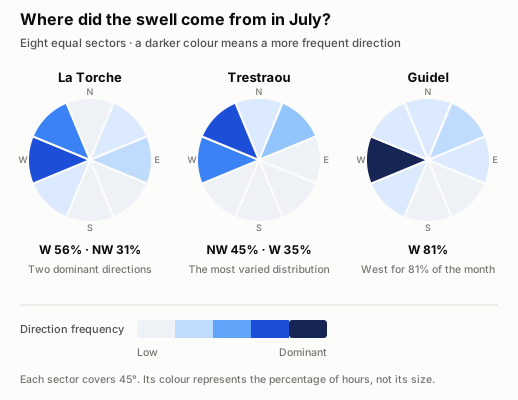
The two most active swell events show this difference clearly. On 1 July, the swell stayed westerly all day at La Torche and Guidel. At Trestraou, it moved between west (71%) and north-west (29%). From 25 to 27 July, it came almost entirely from the north-west at La Torche and Trestraou, while Guidel remained mainly westerly (79%).
This variation helps explain the gaps between areas. The same weather system does not send the same amount of energy to every spot: the swell angle and the exposure of the coastline make a major difference.
To understand the difference between offshore swell and waves at the beach, read our analysis of why the swell forecast is not enough to predict the waves at Trestraou.
Offshore swell height does not tell the whole story either. The chart below shows the estimated wave height at the spot — the value that really matters for a session — day by day, with a colour representing the quality rating.
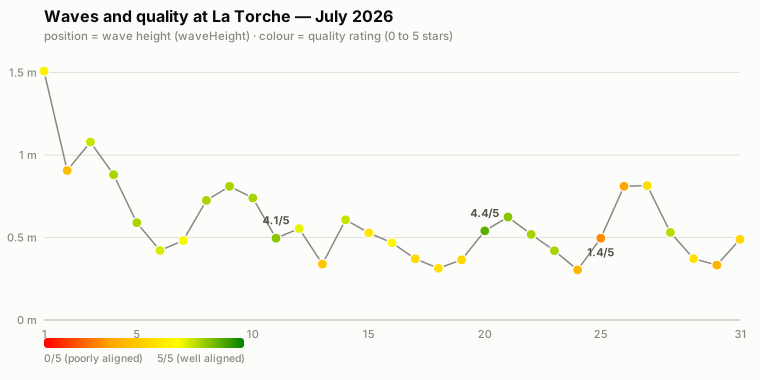
The two largest swell events were not the best moments of July by this measure. The 1 July peak reached at Sainte-Barbe on a wave of only 0.40 m. On 26 July, the rating at La Torche dropped to , despite a wave of around 0.80 m: the swell was there, but it was poorly timed or spoiled by the wind. The month's best ratings actually appeared during the quieter period from 11 to 21 July. La Torche reached on 20 July, with a wave of only around 0.50 m. This highly rated time window suited the intermediate profile, but the wave was too small to qualify for the advanced profile. A small wave with the right direction and tide received a better rating than a larger but poorly aligned wave.
The same principle appears in the other three areas. The following sections include the same chart for the most representative spot in each area.
South Finistère: Baie des Trépassés, Penhors, La Torche
This was by far the most consistent area of the month. All three spots face west, and the results reflect this exposure.
| Spot | Intermediate (days/31) | Advanced (days/31) |
|---|---|---|
| Penhors | 21 | 6 |
| La Torche | 17 | 7 |
| Baie des Trépassés | 16 | 6 |
Penhors ranked first for intermediate surfers with 21 days. For advanced surfers, La Torche finished one day ahead (7 against 6) and had a clearer advantage in quality: 4 days reached at least during their best time window, compared with 2 at Penhors and 2 at Baie des Trépassés.
North Finistère: Penfoul, Petit Minou, La Palue
This area was well behind, although La Palue still offered a few possibilities.
| Spot | Intermediate (days/31) | Advanced (days/31) |
|---|---|---|
| La Palue | 8 | 3 |
| Penfoul | 0 | 0 |
| Petit Minou | 0 | 0 |
Petit Minou stayed below 0.50 m throughout the month, with no suitable intermediate or advanced time window. Penfoul was never large enough to reach the intermediate level. La Palue provided the area's only fairly regular options, with 8 intermediate days and 3 advanced days. However, only 3 intermediate days and 1 advanced day reached during their best time window.
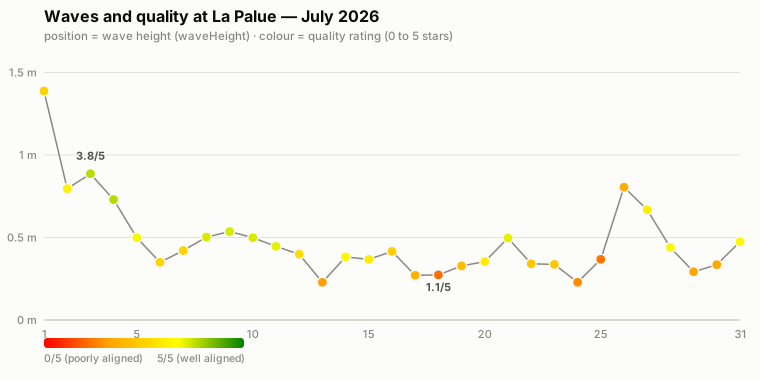
At La Palue, quality followed wave height quite closely. Unlike La Torche, the second half of the month offered almost nothing with a good rating.
Northern Brittany: Moulin de la Rive, Trestraou, Grèves d'en Bas
The month was almost empty for the two levels studied.
| Spot | Intermediate (days/31) | Advanced (days/31) |
|---|---|---|
| Grèves d'en Bas | 3 | 0 |
| Trestraou | 0 | 0 |
| Moulin de la Rive | 0 | 0 |
Trestraou and Moulin de la Rive did not exceed 0.50 m during the month, so neither had a suitable intermediate or advanced time window. Grèves d'en Bas produced only 3 intermediate days, and none of their best time windows reached . This was the only one of the four areas where no spot offered a single advanced day in July.
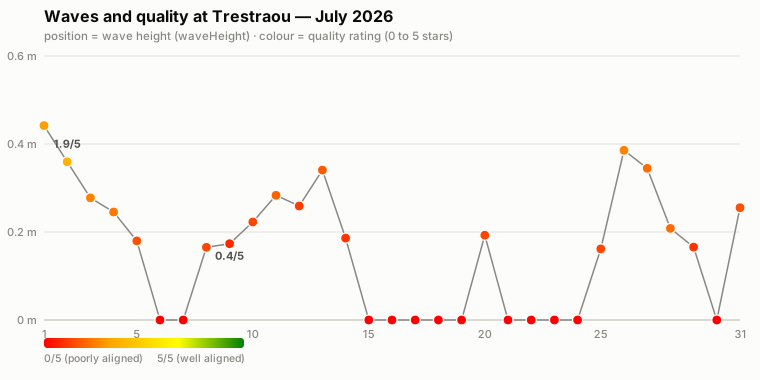
The Trestraou chart is clear: twelve completely flat days during the month, and a maximum quality rating of only , even on the least disappointing days.
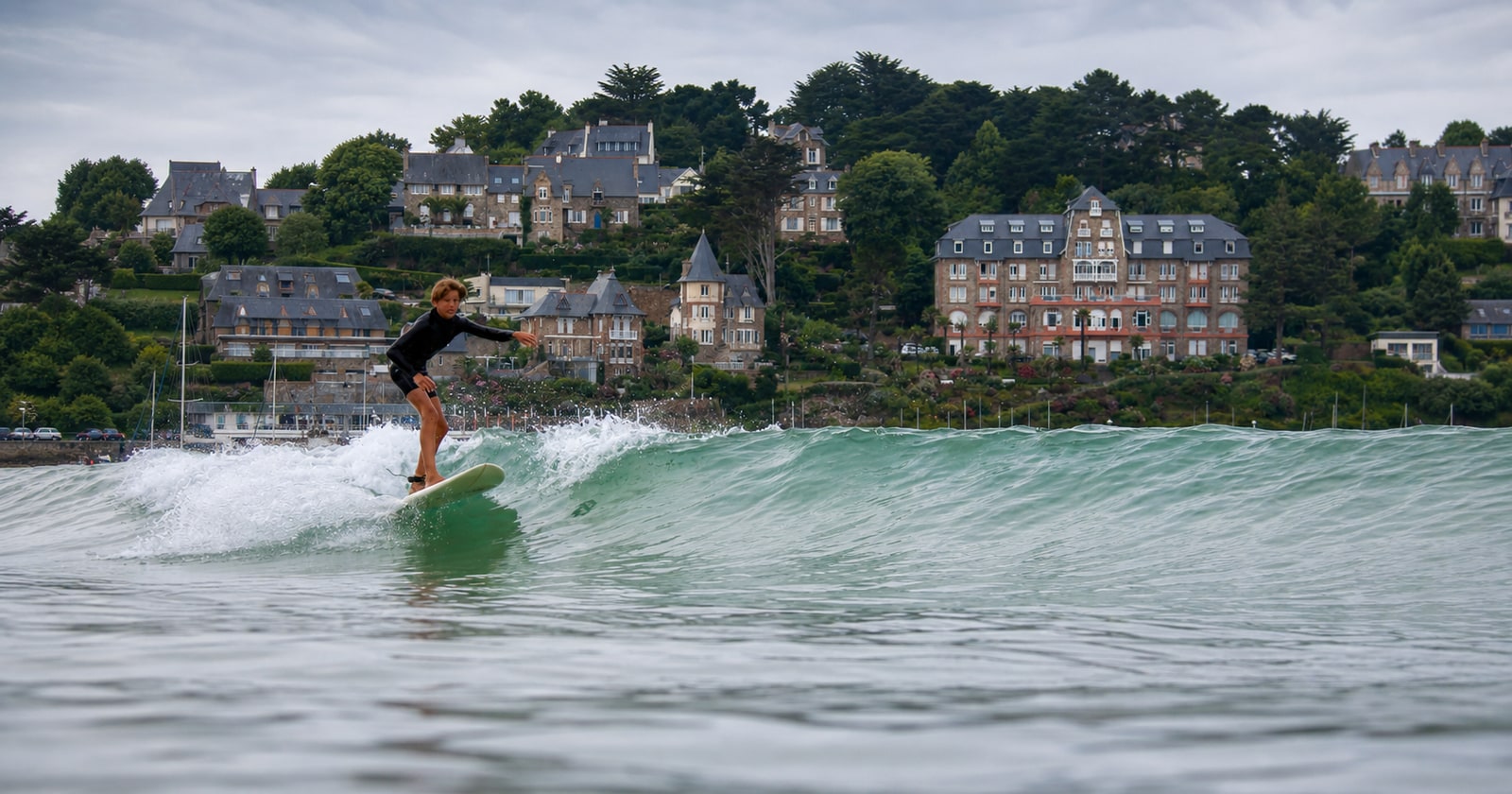
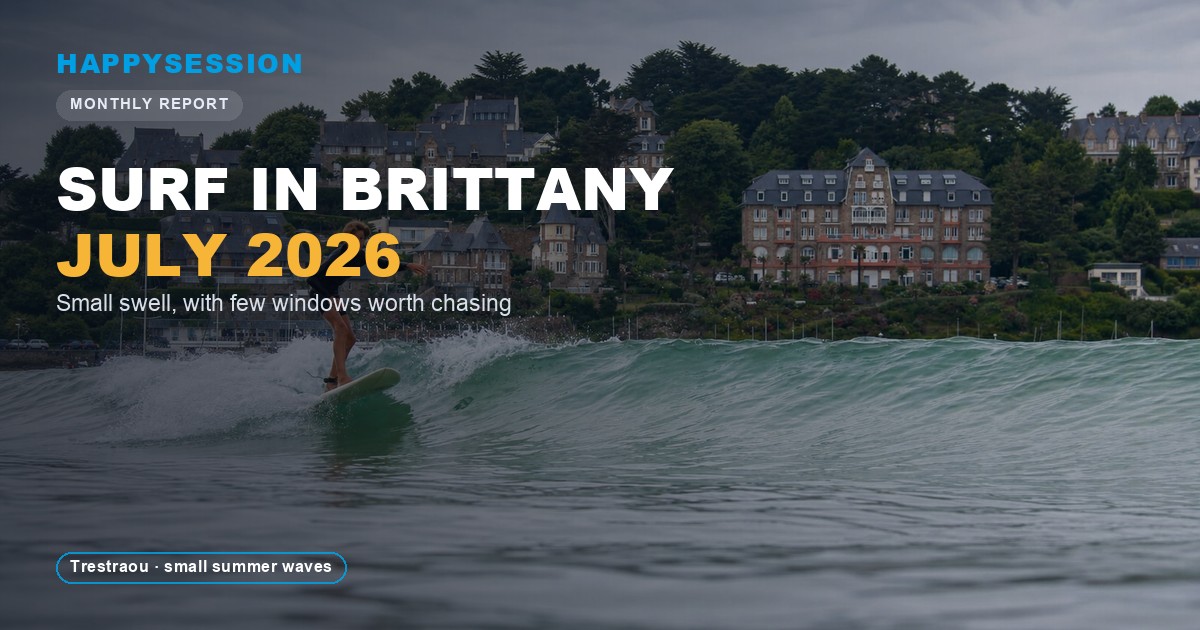
Trestraou in summer: a few small sections, but not enough for the intermediate and advanced surfers studied in this report.
Southern Brittany: Guidel, Sainte-Barbe, Port Rhu
Port Rhu provided almost all the opportunities for the two levels studied in this area.
| Spot | Intermediate (days/31) | Advanced (days/31) |
|---|---|---|
| Port Rhu | 6 | 1 |
| Guidel | 1 | 0 |
| Sainte-Barbe | 1 | 0 |
Guidel and Sainte-Barbe each had only one intermediate day. That day at Sainte-Barbe still included a time window rated . Port Rhu was the main intermediate and advanced option in the area, with 6 days and 1 day respectively, but only one of its intermediate days reached .
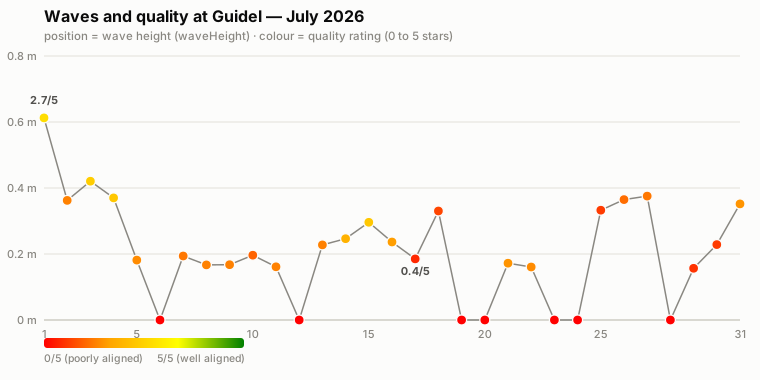
At Guidel, 1 July was the best moment of the month, with , although it did not reach 3/5. The rest of the month alternated between small windows and flat days, without any strong session.
Suitable does not always mean good
The number of suitable days tells us that at least one time window remained within the limits of the profile. It does not tell us whether the waves were good. To go further, we selected the best quality rating for each suitable day among the time windows that matched the level. This rating uses the same five-star display as HappySession, with the exact score shown next to it. In the chart, each bar represents all 31 days of the month. The colours divide suitable days by quality level, while grey means that no time window matched the profile.
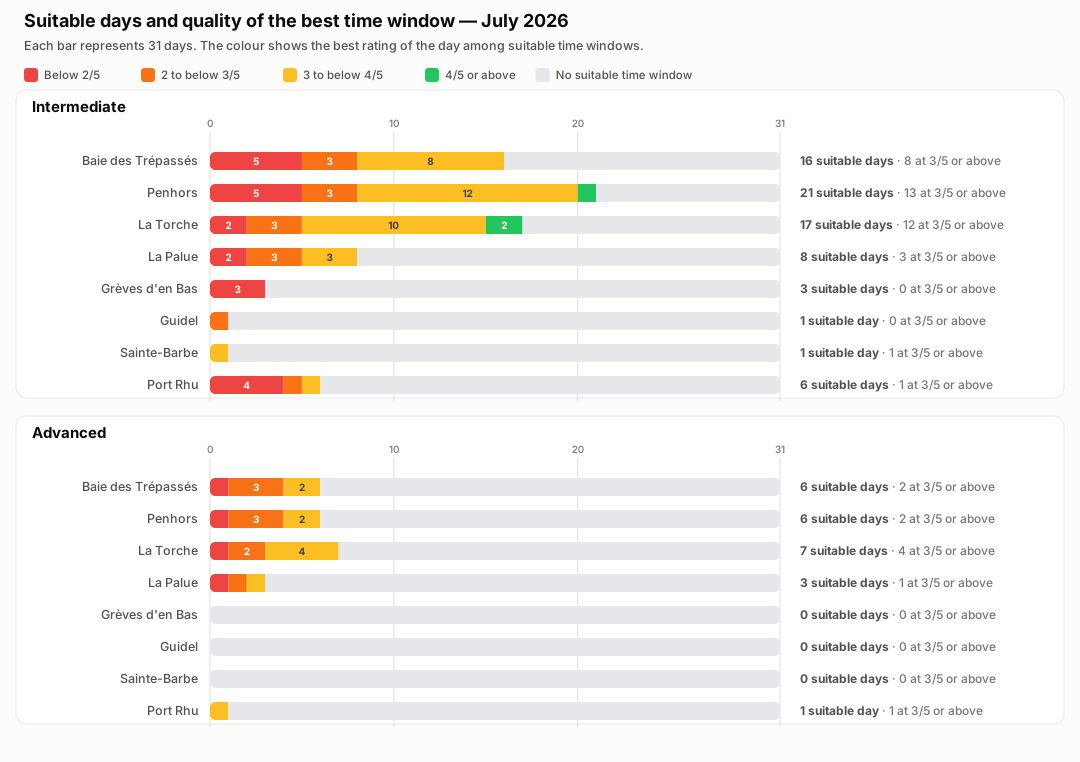
For an intermediate surfer, Penhors was the most consistent choice, with 13 days at or above. La Torche had almost as many (12) over fewer suitable days and recorded the best average quality for the best daily time window: , compared with at Penhors.
For an advanced surfer, La Torche stood out more clearly: 4 days at or above, compared with 2 at Penhors and 2 at Baie des Trépassés. These days were concentrated on 1, 3, 4 and 9 July. No advanced day reached at any of the twelve spots.
The twelve spots at a glance
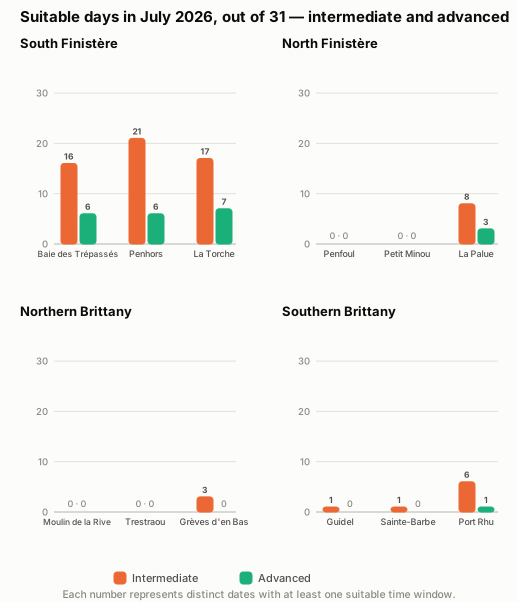
South Finistère offered the most consistent possibilities for intermediate and advanced surfers. Each of its three spots recorded between 16 and 21 suitable intermediate days, and between 6 and 7 advanced days. Outside this area, no spot exceeded 8 intermediate days or 3 advanced days.
Which area and spot should you choose?
Let's be honest: across the twelve spots studied, July 2026 was a poor month for surfing in Brittany, especially for advanced surfers. Intermediate surfers could still rescue their month in South Finistère, particularly at Penhors and La Torche. For advanced surfers, the result was much worse: no day reached across the twelve spots.
La Torche just about limited the damage for the most motivated surfers, ready to chase the few decent windows: 7 suitable advanced days, but only 4 at or above. It was the best choice of the month for this level, but it was not evidence of a good month of surf.
This result will not surprise regular local surfers. Summer months are rarely the most consistent in Brittany. July was a clear example: a few windows worth catching, no memorable swell event, and almost nothing on Brittany's north coast.
The best choice is still the one that matches your level, the exact time window and the conditions at the spot. To plan your next session, check the surf forecast on HappySession.
Did you surf at one of these spots in July? We would like to hear what you found, especially if the conditions in the water were different from this report.
Important information
HappySession provides estimates based on available data and a surf-focused analysis. Actual conditions may differ. Every surfer remains responsible for their own safety and should always be careful.